TopicsPolitician AnalysisAnwar Ibrahim
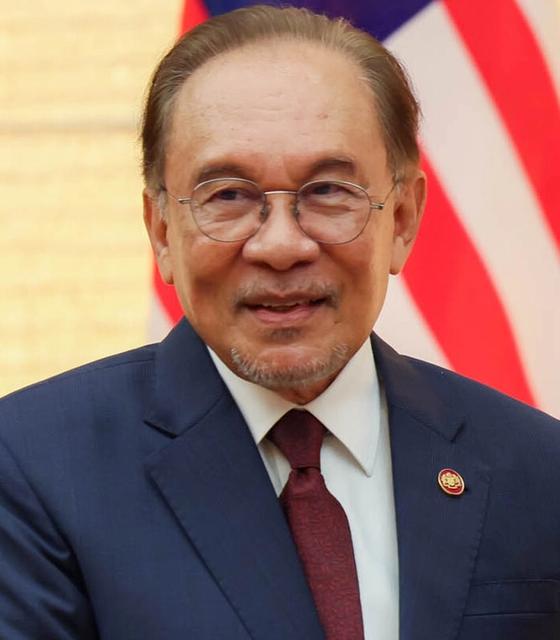
Anwar Ibrahim
- Party
- PKR · People's Justice Party
- Coalition
- PH
- Constituency
- Tambun
- State
- Perak
Why this matters to you
As Prime Minister, Anwar sets the federal policies that reach every Malaysian — subsidy rationalisation, wages, cost of living, and the pace of institutional reform. His decisions on the Unity Government's balance with BN, the timing of GE-16, and how far to push the Madani agenda will shape the country you live in over the next 18 months.
Party History
- Career span
- 1982–2022
- Career win rate
- 90%
- Hop win rate
- 100%
- UMNO
- PKR
See every switch
- 2008UMNOPKR🔀won
Data from Lompat (by Zach Yek), built on the Malaysian Election Corpus (by Thevesh Thevananthan). CC0.
Summary
Anwar Ibrahim is Malaysia's 10th Prime Minister and Member of Parliament for Tambun, Perak, sworn into office on 24 November 2022 at the head of a national unity government after decades as an opposition leader. A co-founder of PKR and longstanding reform advocate, he also serves as Finance Minister and has framed his administration around the 'Malaysia Madani' vision centred on economic reform, anti-corruption governance, and multiracial inclusivity. His political career spans over four decades from UMNO membership, dismissal, and imprisonment to eventual return to executive power.
Biography
Anwar bin Ibrahim (born 10 August 1947, Cherok Tok Kun, Bukit Mertajam, Penang) is a Malaysian politician serving as the 10th Prime Minister of Malaysia since 24 November 2022 [1]. A member of the People's Justice Party (PKR), he represents the Tambun parliamentary constituency in Perak since 2022 and concurrently holds the Finance Minister portfolio [1]. He is president of PKR since 2018 and chairman of the Pakatan Harapan coalition since 2020 [1]. Anwar graduated from the University of Malaya and, prior to entering electoral politics, served as president of the National Union of Malaysian Muslim Students and co-founded the Malaysian Islamic Youth Movement (ABIM) in 1971 [1]. He joined UMNO in 1982, rapidly ascending to serve as Minister of Education (1986), Minister of Finance (1991), and Deputy Prime Minister (1993) [1]. He was dismissed from all positions and expelled from UMNO in September 1998, triggering the Reformasi political movement [1]. After founding PKR and serving years in opposition — punctuated by periods of imprisonment — Anwar was granted a royal pardon in May 2018 following the Pakatan Harapan victory in the 14th general election [1]. He returned to Parliament via the 2018 Port Dickson by-election [1]. Following the 15th general election in November 2022, which produced Malaysia's first hung parliament, Anwar was sworn in as Prime Minister after securing the support of a broad unity coalition [1]. His government, branded the Madani government, has pursued structural economic reforms, anti-corruption initiatives, and active economic diplomacy [2][3].
Known for
Anwar Ibrahim is defined politically by his decades-long reform advocacy, originating with the Reformasi movement he initiated in 1998 following his dismissal as Deputy Prime Minister, and his role in forging the Pakatan Harapan opposition coalition that ended Barisan Nasional's 60-year rule in 2018 [1]. As Prime Minister, he has framed his administration around the 'Malaysia Madani' vision centred on economic reform, anti-corruption governance, and multiracial inclusivity [2].
Political positions
Anwar has consistently championed institutional reform, judicial independence, and anti-corruption governance as central policy priorities. Under his Madani Economy framework, his administration has initiated structural economic plans including the New Industrial Master Plan 2030, the National Energy Transition Roadmap, and the National Semiconductor Strategy, targeting at least five per cent annual economic growth and high-value-added industries [2]. On fiscal matters, he has retained the Finance Minister portfolio and implemented targeted subsidy rationalisation for diesel and electricity to reduce the national deficit [2]. On anti-corruption, Anwar has set a target of placing Malaysia in the top 25 of the global Corruption Perceptions Index by 2033, and his administration reported recovering RM15.5 billion in funds lost to corruption, leakages, and smuggling between 2022 and 2025 [2][4]. On foreign policy, Anwar has emphasised economic diplomacy, pursuing energy and investment agreements with Gulf states, China, Russia, and Turkmenistan, and served as ASEAN Chair in 2025–2026 [3][1]. He has articulated a vision of multiracial harmony and social inclusivity, consistently calling for dialogue over ethnic and religious division [3].
References
Education
- 1968–1971Studied at the University of Malaya; served as president of the National Union of Malaysian Muslim Students (1968–1971).⛓
Before politics
Political career
- 1982Joined UMNO and was elected as MP for Permatang Pauh in the 1982 general election, entering cabinet as Deputy Minister in the Prime Minister's Department.⛓
- 1986Appointed Minister of Education, introducing major curriculum policies including renaming the national language from Bahasa Malaysia to Bahasa Melayu.⛓
- 1991Appointed Minister of Finance, playing a key role in Malaysia's economic management including the country's response to the 1997 Asian financial crisis.⛓
- 1993Appointed as Malaysia's 7th Deputy Prime Minister.⛓
- September 1998Dismissed as Deputy Prime Minister and expelled from UMNO, triggering the Reformasi political movement.⛓
- August 2008Won the Permatang Pauh by-election with 31,195 votes, returning to Parliament as Leader of the Opposition after his political ban expired.⛓
- October 2018Won the Port Dickson by-election with 31,016 votes and a majority of 23,560 votes, returning to Parliament following a royal pardon received in May 2018.⛓
- 2018–2020Became president of PKR in 2018 and, in 2020, chairman of the Pakatan Harapan coalition.⛓
- 24 November 2022Sworn in as Malaysia's 10th Prime Minister by the Yang di-Pertuan Agong following the 15th general election, heading a national unity government after winning the Tambun seat with a majority of 3,736 votes.⛓
- 3 December 2022Formed the Anwar Ibrahim Cabinet, retaining the Finance Minister portfolio for himself, consisting of members from PH, GPS, UMNO and other coalition partners.⛓
Election history
Stance evolution
Public statements grouped chronologically. The party tag shows which party the politician was contesting under at that point.
- 2025PKR
We believe that an unwavering commitment to combating corruption will enhance national and regional competitiveness, foster a dynamic business environment, and ensure inclusive economic growth that reaches all segments of society, especially youth, minorities, and marginalised communities.
- 2024PKR
We need to save the country. The primary issue is poor governance coupled with systemic corruption.
Perspectives on key issues
- GovernmentAnwar's administration frames the Madani government as delivering structural economic reform, anti-corruption progress (including RM15.5 billion recovered), and a stable unity coalition that has surpassed the longevity of the preceding three prime ministers.⛓
- ExpertPolitical analyst Prof Datuk Dr Sivamurugan Pandian attributed the Unity Government's longevity to Anwar's ability to harmonise relationships between coalition parties and navigate constant political challenges, including the Dubai Move episode.⛓
- ExpertGeostrategist Prof Dr Azmi Hassan noted that government stability and Anwar's engagement with foreign leaders instils confidence in investors, and credited the administration with laying foundations for institutional reform in the judiciary and public services.⛓
- OppositionPerikatan Nasional declined to join the unity government after GE15 and assumed the role of official opposition, contesting Anwar's parliamentary mandate arising from the hung parliament outcome.⛓
- VerifiedFactsAnwar won the Tambun seat in GE15 (19 November 2022) with a majority of 3,736 votes, defeating incumbent Ahmad Faizal Azumu of BERSATU, Aminuddin Md Hanafiah of UMNO, and Abdul Rahim Tahir of PEJUANG. He was sworn in as Prime Minister on 24 November 2022.⛓
Notable legal history
Anwar Ibrahim has two sets of finalised criminal cases. First, following his dismissal from government in September 1998, he was convicted of corruption in April 1999 and sentenced to six years in prison; he was also convicted of sodomy and sentenced to nine years. The Federal Court overturned the sodomy conviction on 2 September 2004 and he was released having served the corruption sentence (Source: en.wikipedia.org). Second, in a separate sodomy case (Sodomy II), his acquittal was overturned by the Court of Appeal in 2014; the Federal Court upheld the conviction in 2015 and he was imprisoned; he was granted a royal pardon by the Yang di-Pertuan Agong and released in May 2018, restoring his political rights (Source: en.wikipedia.org). Both cases are fully resolved.
Sources
Every URL the AI used to draft this profile, for editor and reader verification.
- en.wikipedia.org
- en.wikipedia.org
- en.wikipedia.org
- en.wikipedia.org
- en.wikipedia.org
- en.wikipedia.org
- en.wikipedia.org
- en.wikipedia.org
- en.wikipedia.org
- en.wikipedia.org
- bernama.com
- bernama.com
- bernama.com
- malaymail.com
- malaymail.com
- malaymail.com
- malaymail.com
- malaymail.com
- thestar.com.my
- commons.wikimedia.org
- spr.gov.my